
Palo Alto Directory Shelf
The Palo Alto directory collection is local, useful, and not fully summarized in one public shelf list. Rinconada Library houses the physical Local Interest Collection, original newspaper microfilm, historical materials administered with PAHA, and reference help. Documented local research uses Palo Alto city-directory volumes from 1955 through 1976. Other Polk, telephone, and reverse-directory years need a catalog or PAHA shelf check before a visit. Digitized Palo Alto directory scans and genealogy databases add access, but a missing online scan does not prove a missing local volume.
| Collection | Verified scope | Where held | Access |
|---|---|---|---|
| Palo Alto city directories | Documented use, 1955-1976; wider run needs confirmation | Rinconada / PAHA; digitized scans | Library, scan, or reference request |
| Reverse or criss-cross volumes | Mid- and late-century holdings; exact years not published | Rinconada / PAHA | Ask for address-order volume |
| Telephone directories | Historical local runs; exact range needs catalog check | Rinconada, PAHA, Stanford collections | Onsite or catalog inquiry |
| Obituary Index | 1890 to present | Palo Alto City Library | Free online search and article retrieval |
| Local News Index | 1989 to present citations | Palo Alto City Library | Online citation and microfilm follow-up |
| PAHA archives | Photos, oral histories, clippings, organizations, businesses | Rinconada / PAHA | Reference request or onsite work |
Call the library reference desk at (650) 329-2436 or write to pa.library@paloalto.gov before relying on a year run. That small step keeps a local directory search honest about the research gap.
Reading a Palo Alto Directory Entry
A printed Palo Alto volume is an index with editorial conventions. Begin with the title page and abbreviation key. An alphabetical entry may give surname, given name or initials, spouse in parentheses, widow notation, occupation, street address, business address or telephone, and an ownership or occupancy code in some publisher formats. The same book may include a classified business section and a criss-cross section that reverses the name-to-address order.
Read the entry as a statement about what the canvass or publisher listed in that edition. It is not a complete census. A person can be absent because of a move, a non-listing, a married-name change, a publication gap, or an indexing error. A listed adult at an address is a useful lead. Confirm a title claim with the Recorder, a household date with the census, and a death claim with an obituary or vital record.
- Householder index
- An alphabetical name sequence that points from a person to a street address or business location.
- Criss-cross directory
- An address-first sequence that lists a house number, street, occupant or business, and sometimes a telephone.
- Abbreviation key
- The publisher’s guide to short forms for occupations, relationships, ownership or occupancy marks, and other entry codes.
- Listed occupant
- A person printed at an address for a particular edition, not a guarantee of every person present.
Photograph or transcribe the title page, year, page, exact spelling, and abbreviation key together. That record makes later comparison far easier.
Alphabetical and Criss-Cross Searching in Palo Alto
Alphabetical city directories answer a person-to-place question. Start with surname variants, initials, diacritics, married names, and compound surnames. Record the entire entry, not only the address. Spouse notation, occupation, telephone, and a changing street can separate two people with the same name. Then turn to the criss-cross section when the name is unknown. Search the street, house number, neighboring numbers, and any business mark.
This two-way method is especially valuable for a house history. An old address may carry a prior number or the place name Mayfield. A directory can show the same street number with different names in consecutive editions, but the pattern must be checked against subdivision maps, deeds, permits, and newspaper notices. A criss-cross volume is a historical tool, not a current block roster.
When a directory find needs current-record verification, the Palo Alto resident lookup workflow separates a historical listing from a modern identity match.
Trace a Palo Alto Household
A household trail works best when each edition is treated as a dated observation. Do not leap from one year to a conclusion. Preserve the page, spelling, address, spouse mark, occupation, and first or last appearance. Then compare the next available edition and note any change.
- Fix the address and older place name. Account for Mayfield before reading a south Palo Alto entry as missing.
- Start with the latest available alphabetical volume and copy the entry exactly.
- Move backward one edition at a time. Mark spelling, spouse, widow notation, address, occupation, and telephone changes.
- Switch to criss-cross order when the household name is unknown. Read adjacent numbers for a block clue.
- Pair a directory snapshot with the 1940 or 1950 federal census, the newest publicly released enumeration in this series.
- Search newspapers and the obituary index for moves, weddings, deaths, society notes, and property events.
- Use a deed chain for title and a permit file for building chronology. Keep those claims distinct from directory listings.
The result is a chronology with sources, not a polished story that hides uncertainty.
Palo Alto Directories and 1950 Census
Federal census schedules provide household context that a city directory may not. The 1940 and 1950 enumerations can add age, birthplace, relationship, and household composition to a directory address. The 1950 census is the newest publicly released enumeration under the 72-year rule, while the 1960 census is due in 2032. Use the directory to locate a likely year and the census to test whether the household pattern fits.
Do not treat a census or directory as a deed. A directory may list one adult at a house. A census may reflect the enumerator’s visit. A recorded instrument shows a legal transfer. Each source has a different date and purpose, so compare exact addresses, relatives, age ranges, and nearby names rather than letting one match carry the whole conclusion.
HeritageQuest through the Palo Alto library includes census images and family histories. Ancestry Library Edition offers broader collections but is available only inside library buildings. Those access limits matter when a remote scan appears to stop.
Search Palo Alto Newspapers Since 1870
Newspapers widen the historical trail. Palo Alto’s named local runs include the Mayfield Enterprise from March 5, 1870 to May 3, 1871; Palo Alto Times from 1893 to November 23, 1905; Palo Alto Live Oak from October 28, 1896 to 1903; Palo Alto Press from 1901 to 1902; The Daily Palo Alto from September 3 to December 17, 1902; Citizen from March 5, 1904 to December 31, 1905; Palo Altan in 1905-1906 and 1912-1914; and Daily Palo Alto Times from January 9, 1908 to 1918.
Search a surname with a street, spouse, church, school, club, business, or obituary term. OCR errors make variant spelling useful. Browse around a known date when an exact keyword fails, especially on small type or damaged microfilm. NewsBank covers local titles from 1978 to the present in the library service, while the Local News Index supplies citations from 1989.
The Palo Alto Library genealogy and local-history portal is the practical starting point for digital newspaper, obituary, and database access.
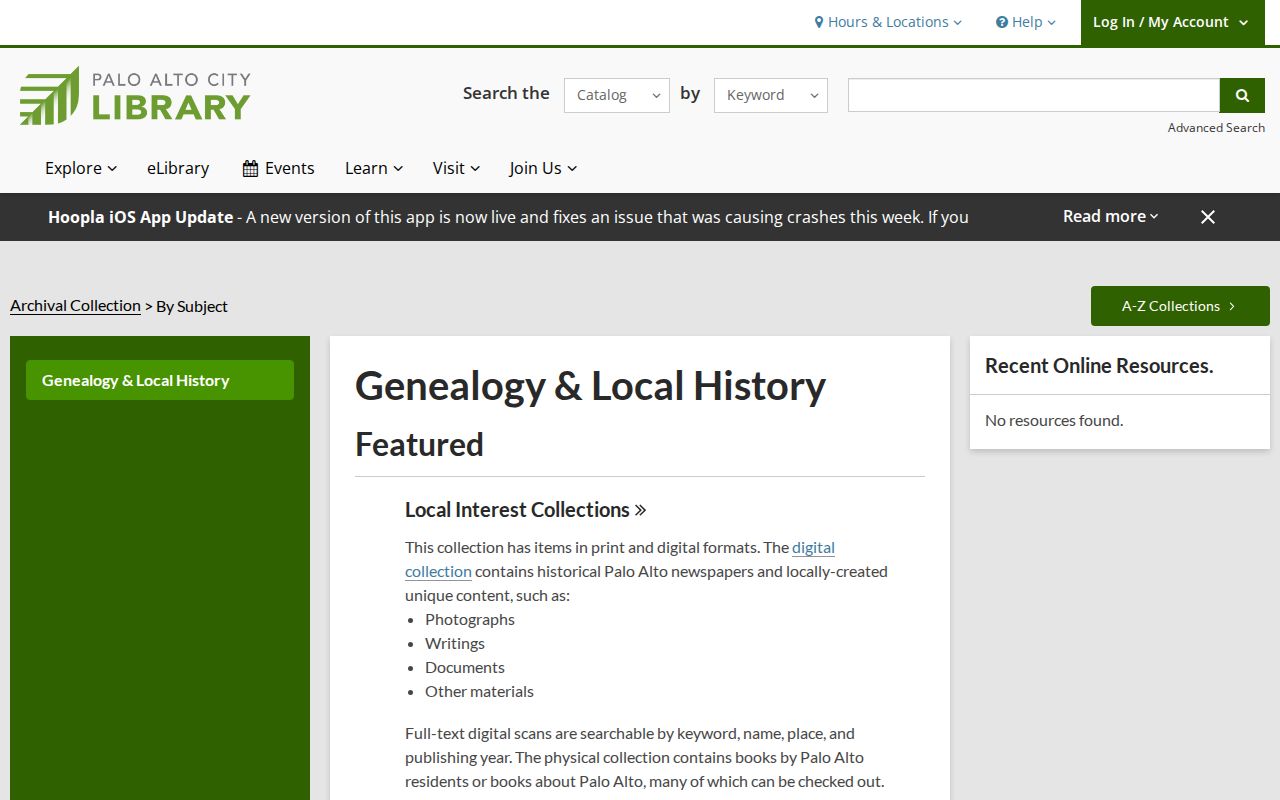
The image points to the physical side of a directory search. Original microfilm and local volumes remain important when a digital keyword misses a page.
Use the Palo Alto Obituary Index
The Palo Alto obituary index reaches from 1890 to the present. It can connect a directory listing to a death notice, relative, former address, organization, or service date. A citation is not the same as the article. Retrieve the item online when available or ask Rinconada staff for the cited microfilm issue. Compare the result with a county or state death record before treating the date as settled.
Obituaries also lead to probate. A Superior Court probate case may name a decedent, representative, counsel, heirs, notices, or distribution events. A later recorded deed can show a transfer from an estate. Keep names, dates, and legal roles exact. An obituary’s family language is useful context, but the court and recorder carry different authority.
Search tip. If the index returns nothing, try initials, a married surname, a place name, or a nearby issue date before deciding that no notice exists.
Palo Alto Directory Entries Say Mayfield
Mayfield’s 1925 annexation is a key Palo Alto city directory quirk. Earlier southern-area records may use Mayfield in the title, place field, newspaper, or address sequence. Later volumes use Palo Alto. A search that keeps only the modern city name can hide the start of a household trail.
Bridge the names with the parcel, not assumption. Compare lot, block, tract, subdivision, APN ancestry, street geometry, and neighboring numbers. The same family may also appear under a changed spelling or a different directory publisher. Anna Zschokke’s 1896 “Pioneer History” adds a narrative view of early births, deaths, weddings, construction, and civic improvements, including the reported rise from 37 people at the start of 1891 to 750 by the end of 1893.
Beyond the Palo Alto Historical Shelf
PAHA holds photographs, oral histories, obituaries, organizational and business archives, publications, ephemera, and clipping files. Stanford University Libraries and University Archives add yearbooks, student publications, faculty papers, photographs, and institutional history, subject to access limits for recent records. The California State Archives and the Online Archive of California finding aids help locate state-government and archival collections.
PAHA’s public research program is linked from pahistory.org. A collection finding aid can identify an organization or event without exposing a private membership roster. Church, veterans, fraternal, and ethnic-community archives may hold older material but set their own permissions.
The California State Archives finding aids image below is a reminder that a historical search may leave the local shelf and enter a creator-based archive. Search by person, organization, record group, or subject before writing to staff.
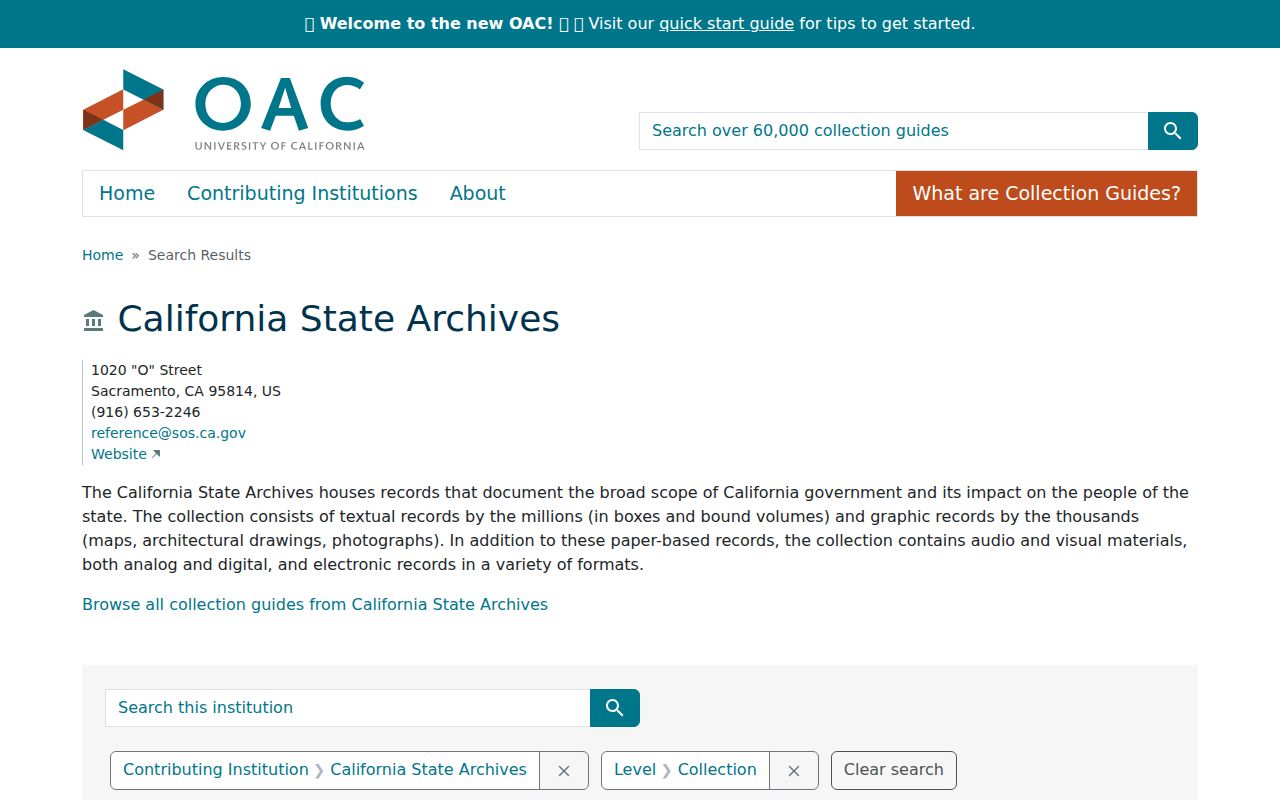
Use archival material to add context and leads. Confirm a current or legal claim with the office that created the record.
Palo Alto Directory Limits
The Palo Alto volume records a publication’s listing decision. It does not certify that the named person owned the parcel, remained there all year, or represented every member of the household. A business address can be separate from a residence. An ownership or occupancy code can vary by publisher. A gap can reflect non-listing, a move, a changed street number, or a missing volume.
Use directory pages for genealogy, house history, reconnecting with classmates, family research, and local history. Do not turn a historical listing into a claim about a protected current address. The California Public Records Act governs existing public records, while Safe at Home, confidential marriages, adoption files, sealed cases, and protected voter information remain outside a directory search.